
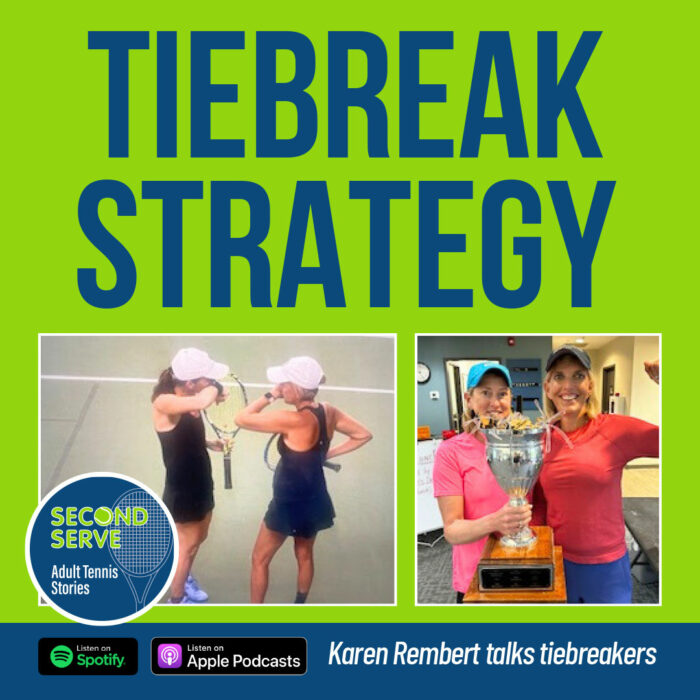
Can mastering your mental game truly transform your tennis performance? Karen Rembert thinks so, and she’s back for part two of our tiebreakers series to show you how. Get ready for an episode packed with actionable tips from Karen on how to stay mentally sharp during those high-pressure moments. Learn the art of self-talk, and discover how to maintain your composure. In addition, Karen gives a few pieces of advice for levels 2.5 to 4.0!
Karen was a National USTA Finalist in 45 Doubles, a two-time NC State 25 Doubles Champion, and ranked #11 nationally in NAIA Doubles.
If you would like to learn more about her camp please check out her facebook page at Costa Rica All Inclusive Tennis Vacations, email her at kr.crdg@gmail.com, or listen to our episode: The Ultimate Tennis Vacation.
We would greatly appreciate a 5 star rating wherever you listen to podcasts!
Here’s a Transcript of our Conversation with Karen About Her Tiebreaker Strategy
Mental Game in Tiebreakers, Part Two
Carolyn 0:08
Hi, this is Carolyn and I’m here with Erin. This is part two of our episodes on tiebreakers with Karen Rembrandt. In part one, Karen gave us a few strategies and her philosophy on tiebreakers, but here is part two. Do you have any tips for not going away mentally? Because I’ve done that before. I’ve gone into a tiebreak and I go, “I’m going to hit the ball as hard as I can on every single shot.” I mean, it’s so dumb. Or I’m tired, I go in tired and I’m super aggressive, even though I know I’m tired. I don’t know.
Karen 0:39
I think when we talk about your actual strategy, it’s very dependent on who you’re playing and how you’re playing. If you figured out a way to win the second set, you’re going to need to continue to put that pressure on. Whatever it was, if you were lobbing, if you were hitting short, if you were hitting through the ball, you continue that pressure. If you dropped that second set pretty significantly, if there was a definite momentum switch, then you’re probably going to need to change your strategy a little bit. We played a doubles match in a tournament in South Carolina, and there’s also that debate of do you take a break or do you keep playing? I have not figured out the answer to that, but we won the second set pretty handily. We took a break because I thought we were going to be a little too hyped up after winning the second set so easily. I was like, let’s just settle down and not have that letdown. Well, that gave them enough time to decide they were going to switch sides. The deuce player played the ad side, and they came back and kind of steamrolled us. So I was like, okay, we shouldn’t have taken the break, because then we gave them more time to work on their strategy. We had the momentum, probably, but hindsight is 20/20. But I think the biggest thing, to answer your question about how do I not just get mad or be tired, is your self-talk. I’m a firm believer in your thoughts. If you take your thoughts to a stop sign, you have a choice. You can go left and go negative and feel sorry for yourself and mope and make it a miserable experience, and you don’t give them any credit. Or you can go right and tell yourself, “She hit a good shot, I made a mistake, I’m good, I’m ready for the next point.” It’s your choice. And I think that’s true in life too. You can go left or you can go right, but you have to practice it. You can’t just say, “Okay, I’m going to go right.” When you feel yourself going left, you need to stop and go, “No, she hit a good shot. We’re good. It’s 6-5. We’re right in this.” We cannot go down that slippery slope and not recover from it.
Erin 3:00
I think that’s why tennis is both amazing and frustrating, because I definitely went left in my match this weekend. And we’ve done this podcast enough to know, we’ve said this a million times, we should go right. No, it was more that I played against a crazy good slicer. There was no rhythm. She and I have history, there were no niceties. I just didn’t want to be in that match, but I still needed to win it. For my own ego, let’s just say, I needed to not go left and just say, “She is a good player.” After the fact, I can give her big credit. She wins a ton of matches because she plays super unconventionally. But man, we were just frustrated with both her and her partner, emotionally frustrated with them, not even with what shots they were hitting, just that they’re frustrating to play against. After, I was like, I can give them huge credit for being good players, and I see why they win a lot of matches. I just didn’t like the way the tennis was going at the time, and so I went left. Usually I can kind of remember a tiebreaker, and that one I just had that mentality of, “I want to win it, but I just want off the court.” I didn’t want to do the work to get off the court and be the winner. I just wanted to be the winner and get off the court very quickly.
Karen 4:22
Yeah. I wish it worked like that. I wish we could just wish the win. I don’t want to do the work, I just want to wish the win.
Erin 4:29
I know. And I do get that, like, I shouldn’t be in this tiebreaker. I shouldn’t have lost the first set to even be in this tiebreaker. I have to keep some sort of card in my bag to pull out in those situations and say, “Stop. Stop your emotions right now.”
Karen 4:44
All of those thoughts are not helpful for the situation. And then when you look back and you go, “Well, what was I thinking? Why couldn’t I just be in the present?” A lot of times my self-talk is “play a good point, four balls in, be here.” Or “it is what it is.” If I’m not playing well, it is what it is, so figure out a way to win not playing well. But be okay with the battle. I think that’s a lot of us: we get tired, mentally or physically, and we start making excuses, and we don’t just fight the fight and say, “Okay, at the end of the day…” When it takes me a day to go, “All right, they played a good match.” I told Carolyn the story: all the fluff interferes instead of just playing the ball. And I learned this lesson early: especially if you’re irritated with your opponent, if they’re not your friend, if there’s contention, play the ball. Don’t look at them, don’t think about them, just play the ball. It’s the looking at them that can let them get under your skin. Especially if they don’t look like tennis players, you’re like, “What am I even doing out here?”
Carolyn 6:08
You know, I’ve gone there before, like, “I’m really bad at this sport.”
Erin 6:13
I played this same duo a while ago, and we ended up winning in a match tiebreak, but this time I lost. And the whole time I thought, “These two need to take some lessons.” I just kept thinking about their technique. And listen, I know Karen’s watched me play enough. I know I don’t look great, but I’ve taken a million lessons. That was my mentality. In the first match and in this match, I was just like, “I’ve got stuff to do. They’re irritating me.” I should have played the ball. I remember you saying that too in Costa Rica. Play the ball. It’s not easy.
Karen 6:51
It sounds like it’s easy, but it’s discipline and practice, right? And it is amazing. I find myself even now, when I’m doing a drill that I’m terrible at, all I want to do is get out of that drill and do something I’m good at. That’s when we really need to have the discipline and say, “No, you’re doing this drill because you obviously need this drill.” And obviously, going in and playing teams that you know, “All right, the last two times we played, we went to third-set tiebreakers. It’s going to be a battle, and I’m going to stay in it.” If you’re even, you play ten times, it’s probably going to be five and five, and then you just hit the practice courts and work harder next time. It’s more about not beating yourself than beating them, right? Because if you’re battling yourself, now you’ve got two opponents, yourself and them. And your partner’s looking at you going, “I need you here now,” right?
Erin 7:59
Do you have different advice? Because you teach all levels, and just so everybody knows, Karen is a 5.0 right now, and she’s fabulous. Do you teach different philosophies or a different way? Or I guess the better question is, what’s the best advice you can give to the different levels, from 2.5 all the way to maybe 4.0 to 4.5?
Karen 8:22
Yes, there’s definitely different advice, and I could probably say three or four things on each. But what I find most helpful if I’m teaching somebody who’s just starting, a 2.5, and this is true for all levels, obviously, is: have fun. That’s my biggest advice. It’s a game, and there’s so much more than just the tennis. But for the 2.5s, I’m going to say really make sure you learn good technique. It doesn’t have to be great technique, it doesn’t have to be perfect, but if you can start learning with the right grips and have a decent swing path, you’re not going to be limited in how good you can get. So spend the time. If you take a lot of clinics, you might not get that individualized attention. I would rather you take one or two lessons a month, but learn good technique, and that way you won’t be limited in the future. For my 3.0s, it’s keep the ball in play. You’re going to win that match if you can keep the ball in play, and learn how to play the net then, right? You don’t want to get to a 4.0, or a good 3.5, and go, “Oh, I wish I’d learned how to volley.” Learn it then. For the 3.5s, I would say start learning your weapons. Start being able to put your overhead away. Have a decent first serve. When you get a high volley, make sure you can finish the point. The 4.0s kind of have all of those things. That’s why you’re playing 4.0. So for the 4.0, it becomes more mental: being able to adjust your game plan and not go away mentally. When I look at the difference between the 4.0s who have just gotten there and the 4.0s who are going into the 4.5s, they don’t come off the court going, “All they did was lob me. I can’t play that game. If they had been a little bit better, I’d have beaten them.” By that time, they know you have to beat all types of players, and that’s why you’re playing that level. So many times I hear these girls come off the court and they’re like, “I just wanted to hit the ball.” Well, today wasn’t the day that you were just going to be able to hit the ball. Today was a day that maybe you needed to lob over Sally’s backhand and come in behind it and do something different, because what you were doing wasn’t working. So that would be my glossed-over version. But at the end of the day, it’s such a great sport, and we have to have fun, and we’re not making any money playing. And there are the friendships and the things that happen, and especially in our town, the tennis world is small, so carry yourself well. Good sportsmanship. Don’t argue over line calls, don’t be that person, because it carries with you, and that is what makes people quit the game, when it gets more negative than positive. And the positives are so big and so fun. Like I told you, we just played the Cup and we got so much rain, but we still had so much fun. Our last match came off the court at midnight, and then we had to be back out at the courts at 7:30, and we’re tired, but it’s fun. It’s the friendships and everything that goes around it: the exercise, the endorphins it releases, and the social side. So that’s my advice to everybody: be good out there. Be a good person.
Carolyn 12:11
Don’t be a jerk.
Karen 12:15
For goodness’ sake.
Carolyn 12:17
So thanks again to Karen for coming on the podcast. We’ve included more information about her tennis camp in Costa Rica in our show notes. We hope you check out our website, which is secondservepodcast.com. Thanks so much for listening, and we hope to see you on the court soon.