
“Two out of three things right.”
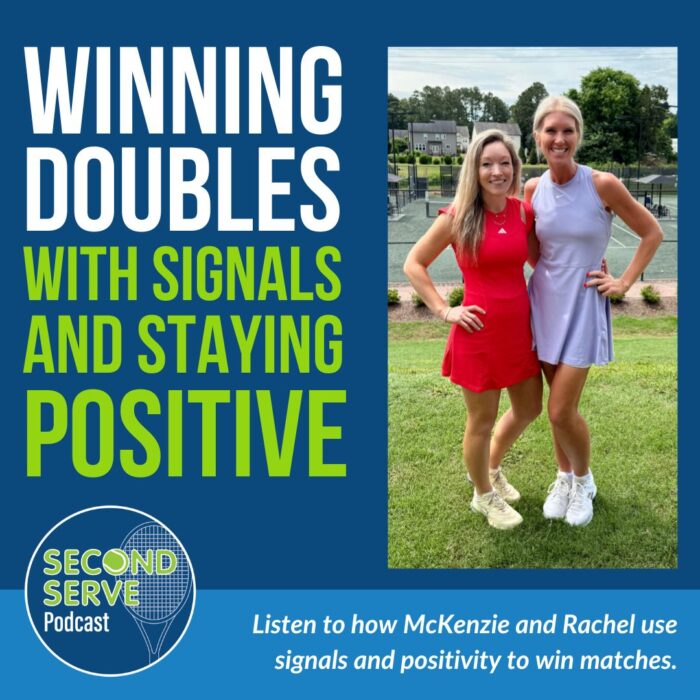
Listen to how McKenzie (NTRP 3.5) and Rachel (NTRP 4.0) use signals and positivity to win matches and enjoy the game. Their strategy secrets may help transform your tennis game!
Here’s a Complete Transcript of our Conversation:
Doubles Strategy with McKenzie and Rachel
Carolyn 0:06
Hi, this is Carolyn and I’m here with Erin, and we are excited to have McKenzie and Rachel on the podcast to discuss doubles strategy. We had Gigi Fernandez on the podcast previously, who is a 17-time Grand Slam champion, and she also coaches rec players. She said even rec players should have a strategy and be running plays and doing planned switches. But I hadn’t seen very many people do this until I played Rachel and McKenzie. McKenzie is a 3.5 and Rachel is a 4.0, and they beat me at the 4.0 level. So using signals and strategy worked for them, and I asked if they would come on the podcast to discuss it. First, can you guys tell us a little about your tennis background? McKenzie, can you start?
McKenzie 0:53
Yes, absolutely. I started playing in my late 30s, really mid-30s, taking a few lessons and immediately falling in love with the game. Then, before I was really able to sink my teeth in, I got married and had children and took a little break, and then returned to the court a little before everything shut down for the pandemic. After another year of playing, I joined a USTA team, and about a year after that I started playing with Rachel. That’s how we met. Even though we went to high school together and had crossed paths a little, we really didn’t become friends until tennis brought us together. Now we play together all the time. How about you, Rachel? How did you start?
Rachel 1:30
Kind of the same thing. I’d had my four kids, and it was right after COVID. I needed to do something outside with my body, and I loved tennis right away. Kenz and I got on a team together kind of by accident, right? When we were 3.5s, and we were both playing a lot of singles, oddly enough. We kind of fell into playing doubles together, and we immediately both realized that we were a little bit nuts for strategy and studying the game, and that we also just love to have fun on the court. Carolyn, when we played you, that was such a wonderful match. Yes, we do strategy, but most of the time we try to circle back to enjoying being out there together, learning and trying to get better every day.
Erin 2:34
Can you give our listeners a few pieces of doubles advice? We’ve had a lot of teaching pros tell us what we should do, but our listeners are 2.5s to 4.0s, and oftentimes we hear that they want advice from people who are on the court, in the trenches. So give us your advice. Rachel, do you want to start?
Rachel 2:57
Sure. I think the biggest thing that elevated our game was the use of signals during our service game. One hundred percent. Not only the server calling the location where she’s going to place the serve, but the server’s partner up at the net responding with what they want to do, whether they want to poach, or fake, or stay. Just knowing in your mind before the ball is even hit what the plan is gives you confidence.
McKenzie and Rachel 3:11
The big thing where we’ve kind of changed is being able to execute on that serve. It’s important to remember that if you say wide and it goes up the T, you’ve got to be ready to push that ball. I also think it helps us just to focus. Especially when the server’s partner is up there and you can see where the returner has lined up. Maybe they’re really crowding the T, so we decide, do we want to jam it at them, or go wide? Sometimes I’ll call it from the front if Rachel’s serving, or vice versa. It also makes us check back in and focus as the point starts. When we don’t play well, it’s because of focus. So the strategy for us is really just to keep us in the point, keep our heads in the game, and make sure we’re communicating. One of our biggest things is that when we stop communicating, that’s when things fall apart for us. So the more we’re talking to each other on the court, the better. Even in a tight match, when we’ve called the serve, it goes where it’s supposed to go, the return comes back, and your partner poaches and gets a good look but hits it in the net, so you miss your poach, Kenz will turn to me, or I’ll turn to her, and go, “Two out of three things are right there. We did two out of three things right.” So we’re always looking toward the next point, and the next match, and staying positive with each other. Because we all know you’re going to miss a volley, or you’re going to fake too early and they’re going to burn you down the line, right?
McKenzie 5:05
Yeah.
Rachel 5:05
Sometimes it doesn’t work out. But having that plan in your mind and staying positive with your partner is a game changer. We’ve lost enough matches that we go, “We don’t want to lose that way. We don’t want to lose because we backed off our plan.” And as she said, one of our pros has said, play to the next match. So we really try to keep building, keep playing and keep trying things.
McKenzie and Rachel 5:28
We’ll go, “Okay, three out of four things went right there. We got the ball we wanted, we just missed that last shot.” Instead of focusing on the miss, it’s “Look what we did well here.” Another thing, and this is one we’ve implemented most recently, is: lose two points, change something up. If you lose two in a row, switch something up. It can be going two back, right? “Okay, we lost two points in a row, now we’re serving at love-30, we’re going to go two back.” Give them a new look. At this level, I find the returner will try to drop it short, so we prepare: who’s going to go if they drop it short? Which one of us is going for that? And who’s going to call it, and who’s going to take it if it comes? We prepare ourselves for that situation, and usually it goes right in the nose.
Erin 6:15
But you’ve made a plan.
Rachel 6:17
We’ve got a plan. It also makes people think more about where they’re going to put the ball. If they’ve kind of got a rhythm, it breaks that rhythm and creates a little chaos for them. They’re thinking a little harder, and usually it draws an error. I’d say about half the time, 50% of those points, we win just by drawing an error from them.
Erin 6:34
The other thing I’ve noticed at our level is that just having a plan, and having your opponents know you have a plan, helps. Even if you fake a signal and just go, “Uh-huh, yep, okay,” they’re like, “Oh man, these people have their act together.” That throws people off. It’s not that a lot of people at our levels don’t have a strategy. It might be “hit to someone’s backhand” or whatever. But those signals you talked about are super important. Honestly, I’m sure if you told a 2.5 to decide where to serve the ball, they’d say we’re just happy to get the ball in the box at that point. But you could maybe just make a planned poach or a planned stay, or just pretend like you’re making a plan. Sometimes even when people get together on the baseline and talk, I always wonder what they’re talking about. Are they talking about where they’re having lunch after? Or are they saying, “Erin’s forehand is clearly better than her backhand, so I’m going to serve to her backhand”? I’m just wondering, and that makes me not focus.
Rachel 7:34
A hundred percent, we’ve noticed that as well. And it’s interesting, you just talked about that. Kenz and I played the Raleigh Racket Club member-guest this weekend, and it was one set, no-ad, so a short set. What we tried to do was identify weaknesses right away. “Okay, they’re running around their backhand in the warm-up.” Whoever you’re warming up with, “They haven’t hit a single backhand,” or “She’s got a short slice forehand, let’s jam her up the middle.” Or we’re going to go Australian. We went Australian when she had that short slice return.
Erin 8:12
You guys did Australian?
McKenzie and Rachel 8:15
Yes, we actually do that a lot. One thing we’ve done with that is to do it on the big points. That’s where we’ve progressed from last year. We would do Australian last year, but we would do it when we were up 40-15. Now we played a match on Tuesday and it was a pretty tight match, and I think it was 30-40 and I was serving, and I said, “Let’s just do Australian.” We did it and we won that point. Then we did I-formation on the next point, and we won that point, and that was our match point. So now we do it on the bigger points. That’s something Jane Foreman said. We did a clinic with Jane Foreman, who I don’t know if you guys follow, but she’s awesome.
Erin 8:54
She’s the one with the glove, right? That’s what I call her. Have you seen that? I’ll show Carolyn. I’m sure a lot of people listening will know who she is. She’s in Florida, right? Miami. She films her doubles clinics and talks to them through the point, and you can see her hand, because she talks with one hand and it has a glove on. She’ll tell you what you did well or what you did really…
Rachel 9:22
She only tells you what you did wrong. We were like, “We want Jane just to yell at us.”
Erin 9:32
I want her just to yell at me and tell me everything I’m doing wrong. That’s so funny. That’s awesome. I didn’t know you did that. That’s really neat.
Rachel 9:39
Yeah, she’s incredible.
Erin 9:41
Let me ask you a question too. Carolyn and I played you a couple of years ago, and this one point will always stand out in my mind. We were at your home club, playing in the Abilities Tennis tournament. We were doing signals. I’m sure I was the server. I was behind Carolyn, she was at the net, and I was supposed to serve it somewhere, maybe wide, and I didn’t. We had our plan, and my serve was so completely not where it was supposed to be. So I want to ask you guys: if the serve doesn’t go where it’s supposed to, do you change your plan in the moment, or do you just go for it? Because I will tell you, Carolyn just goes for it. She had to poach. She’s laughing because it was so significant. I would have thought nobody would poach that ball, but she was like, “I said I had a plan. I’m going for the plan.” Someone actually saw it happen and they were like, “How did she still go for that ball?” And I was like, “Because Carolyn had a plan in mind.” And actually, she won us the point, believe it or not. So what happens with you guys? If you make a plan for a serve or a poach and something goes wrong, do you, because you play together so much, sort of read each other’s minds? And like you said, Rachel, let McKenzie know which balls to let her take and not. Do you change it in the moment?
McKenzie 11:04
Or do you just go? To me, go means go.
Erin 11:08
Or do you do the Carolyn method?
Rachel 11:10
Well, Carolyn, you’re correct. You are supposed to stick with it regardless. And we do not. We abort.
McKenzie and Rachel 11:19
We know we’re going to do that. We could call it all day, and then that ball is way cross court and I am not going after that ball. We know we’re not going to stick with it. And we’ve had pros tell us, “You guys aren’t doing this right.” It’s okay. You’re poaching, and you stayed, and that’s not what we’re supposed to do. So Carolyn is correct.
McKenzie 11:47
Carolyn’s correct. But Carolyn’s not winning, just so you know. They are winning. You won that point.
Erin 11:55
She did. And she’s only saying that because she’s been out of tennis for two years, but she’s coming back strong.
Rachel 12:01
But I do want to say that sometimes you can plan that poach on the side you prefer. For me, my backhand volley, if we do a planned poach, is so effective. I’m going to plan it on this side. You’re serving ad, I’m over here on deuce, I’m going to go. And vice versa. Kenz’s forehand volley is incredible, so it’s more likely we’re going to do it on that side, and you might continue to stick with the plan more on that side. And that backhand volley you do is so unexpected, because it’s such a hard shot, and it’s so good. Thank you, you guys are so kind. But for me, it’s easier to take my backhand volley at the net where it’s supposed to go. You’re supposed to go net player to net player. Don’t ever take that poach back to the baseline player and give them all the time in the world to pass you down the line or send it where they want to send it. For whatever reason, my forehand volley, I feel like, goes back to the baseline every time. It’s like knowing your own limitations.
Erin 13:13
And having your partner know your limitations.
Rachel 13:16
One hundred percent. There are so many points where we just know what the other person is going to do, whether it’s right or wrong. It’s very surprising when we let a ball come between us down the middle. That’s very rare. Or when we get burned because we’re out of position, because we’re so used to each other.
McKenzie and Rachel 13:28
That’s one thing I also think at the club level, at our level of tennis: not having consistent partners. Carolyn, you’ve played with someone different all season, and it’s just not a great strategy. If it’s possible at all, have two partners, or three at the most, in a season. I think that’s just so huge.
Erin 13:55
Yeah. I try to do that as a captain if I can. We kind of poll people and say, “Who do you feel like you play well with? Who do you not play well with?” And then we try our hardest to accommodate that. But we’re not professional players where this is our whole life. Everyone’s got kids to pick up, or a doctor’s appointment.
Carolyn 14:13
Yeah, it was my fault I didn’t have the same partner each time, because of my scheduling. But ideally, is all I’m saying.
Rachel 14:19
It does make a difference, is all. We’re moms who play tennis, and it’s secondary to our real lives. I think the other problem is that some people say, “I can’t play with her, she’s my friend, I don’t want to disappoint her.” That makes a big difference. Kenz and I know that even if I miss that forehand volley four times in a row, I’m going to say, “Keep going.” I look back and go, “Go, girl. Go for it every time.”
McKenzie 14:48
Yep.
Carolyn 14:51
Thanks to McKenzie and Rachel for coming on the podcast. We have another episode where they discuss their receiving strategy, including the secret play they use, and also the craziest situation that’s ever happened to them on the court. We hope you check out our website, which is secondservepodcast.com. Thanks so much for listening, and we hope to see you on the court soon.