
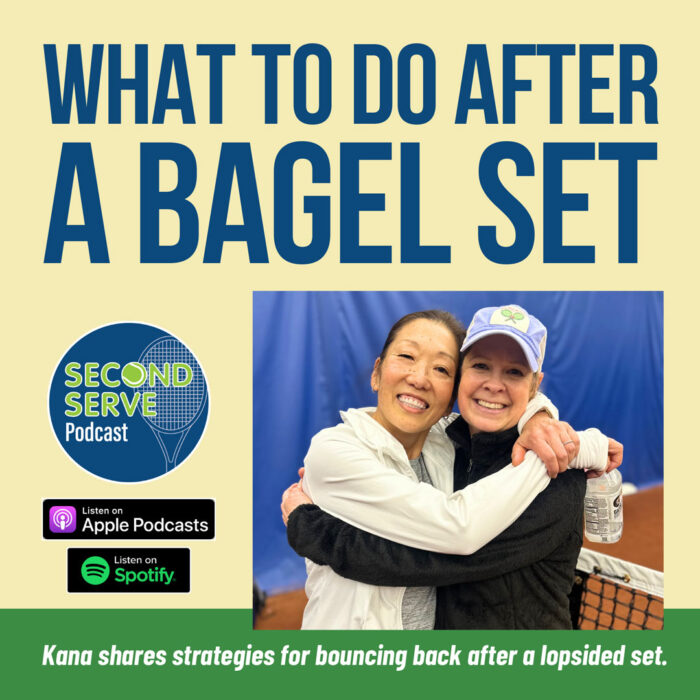
A 6-0 set can mess with your head no matter which side of it you’re on. If you just steamrolled a set, you start thinking, “This can’t last,” and you tighten up trying to protect the lead. If you just got bageled, you can feel stuck with zero clues and zero confidence. We talk through both moments and the exact doubles decisions that may help you stop the swing before it turns into a third-set coin flip.
Here’s a complete transcript of our conversation with Kana:
Carolyn 0:08
Hi, this is Carolyn. I’m here with Erin and Kana is back. And Kana came up with this idea, which is what do you do if you lose zero six? Or if you win six zero. Or if you win six zero. Okay, Kana. And what do you
When A Set Ends 6-0
Carolyn 0:24
do?Kana 0:24
Well, I guess, you know, we just had that experience recently where we won the first set 6-0. And, you know, your first thought is this can’t last. You know, it was one of those sets where everything you touched was a net cord winner or you know, a framer winner, you know, and you think, well, this can’t last that much longer. You know, and also we also had the thought that, well, they’ll probably change everything, right? Switch sides. Should we switch sides? Right. And then, you know, you have this long, you know, conversation about like what you think the opponent is going to do. Um, so I just know from last recently winning that set 6-0, you know, where we talked about switching sides in the anticipation that they were gonna switch sides. And then we thought, well, we’re doing obviously fine on our sides. Do we just stay? Um, which we ended up doing. And we thought the opponent would change everything because when I’ve had the experience of losing 06, we changed everything. We changed sides, we changed serving sides, we changed, you know, every single point was uh Australian eye formation to back. Um, we also play one called the Lynn Goldberg, where if you’re serving from the deuce side, the your partner
Switching Sides And Weird Formations
Kana 1:44
stands on your right. Yeah, picture. Oh, yeah. Wow, I’ve never seen that. That really messes people up. Yeah, I I do it on the ad side so I can get over to the deuce side because the ad side is my much weaker side to be on. So when I serve from the ad side, I would have my partner stand to my left. I serve in the middle, and then scoot over to the the deuce side.Erin 2:08
And it’s weird because it’s a formation you don’t see. You’re allowed to do it. Yeah. Um are your opponents like, what are you guys doing? Yeah, like you’re serve. Sometimes I’ll be like, I’ve seen people do it. I’m like, are they serving from the wrong side? They’re both standing there. What is happening right now? They’re kind of waiting for you to get into the correct formation. Right, right. Yeah. And so there’s a lot of just staring at each other. Right? I love that. I’m gonna try that. Which tends to just mess someone up because it’s a different formation. The problem is, I feel like I also, so if I win a set 6-0 or 6-1, like very, you know, easily, like Kana said, I tend to be more nervous because I’m like, now I gotta hang on to this, right? Like you said, like you lose, right? The second set. And so I I have been in this situation as well recently. And I literally looked at my partner and I said, we are going to pretend like this is the beginning of the match. We did not win a set. We are starting over and we gotta hunker down and we gotta like, let’s win
How To Avoid The Second-Set Letdown
Carolyn 3:10
this set so that you know. Um, so I think of it more psych psychologically, that’s the way I think of it. I’m like, now is not the time to think we won the first set, like, because there’s always that letdown. I think that’s why it’s really common to win a set super easy and then lose a set because you’ve you’re just like, oh, I’ve got this in the bag now. And now you’re in a third set tiebreaker. And now you’re in a third set tiebreaker, which is just a flip of a coin, which is the worst situation you can be in. Yeah. Have you guys ever switched sides in anticipation that they’re gonna switch sides? Like if you win 6-0. Yeah, I know that’s really hard. No, but I had a serious discussion with someone where we were going to, and in retrospect, we completely should have, because it was a better matchup when it was I was with that when I was on the deuce side and we were hitting deuce to deuce, and then that person switched to the ad side, and I had a I struggled much more with their partner. So, really, in retrospect, we should have switched sides. But you know, I guess that’s a Monday morning quarterback thing. Right. And actually, I think the best thing that can happen going into a second set, if you’re questioning whether you should serve, I mean, um switch sides or not, is hopefully you’re the server. A lot of people don’t want to, you know, a lot of people don’t want to serve first because they’re like, oh, I gotta get the jitters out, I might need a game or whatever. Going into the second set, it’s fantastic if you can, if you happen to be the next serving team, because then you can make the decision. Yeah. If you’re the receiver, you got to make it right away. And then you don’t know what they’re gonna do. And and actually, I think there’s many, many times I’ve been played against, you know, my my opponents have played against me and a partner where we’re the receiving team, and so they’re serving, and they see, oh, well, they stayed in that same formation. So we are now going to switch. And so we don’t really have that choice as the, you know, as the opponents. But I think that’s kind of the best scenario scenario you can be in going into a second is being the the team that’s serving first, and then you can make your decision after that first game. Yeah. And and I’m thinking too, you know, a lot of times where it’s happened is with combo, where you have a 3-5 and a 3-0, and all of a sudden they switch sides, and then the whole game changes because somebody’s against somebody else and it just doesn’t work. Yes, especially in combo, I would really consider after winning the first set six, six, oh, six, one or whatever, very, you know, lopsided. I would definitely consider switching. And my only reason sometimes for not, because I often have have a discussion with my partner. Apparently, I learn lose a lot of first, or or maybe, I don’t know, lose a lot or win a lot, lopsided um sets. And I do have that discussion. And it’s one of those things like it’s kind of it’s not, it’s genius if you end up winning that set. It’s terrible if you’ve decided to switch and then you’re like, well, that didn’t work out. But it’s yeah, it’s really tough because sometimes I feel like, just physically feel like, well, I haven’t received a ball on that side now for an entire match. And I’m already nervous. I’m in a USTA match, you know, it matters for nothing, but whatever. Um, and I’m like, oh, I haven’t played at the net on that side necessarily. I haven’t hit a volley, you know, maybe I like my backhand volley more than my forehand volley or something. So I always kind of feel like I have to get my bearings on the court again of like, I haven’t received a ball on that side, on that side, whichever side it is, you know, deucer ad. Um because you’ve been receiving the whole time on the other side. So I think that’s where it gets a little bit tricky is is how you’re feeling about it. And that is uh one good reason. If you get beaten oh six, yeah, then you gotta figure it out anyway. So yeah, what’s the worst that’s gonna happen? You’re gonna get beat oh six again. Yeah. You know, although once uh I was losing a set one six and we decided to switch everything up and we said, what’s the worst that can happen? And we lost the next set six oh six. So there is a worst that can happen. And I actually thought she was lying. I was was that the one I was playing next to you? Oh, a different one. Okay. Yeah. What advice would you have? Let’s say two fives just starting, you lose the set zero six. You guys are now four. Play four five. What advice would you give to them if they’ve lost zero six? I would say go to the bathroom together, talk. It not one person, like you both have to go together and talk about what you’re gonna change, right?
Down 0-6: Change Everything Together
Carolyn 7:25
Yes, and change everything. And I would change everything. Change the side you serve on if you can. Some people are. If they’re liking hardballs, you gotta go to your moon balls, you gotta go to the lob, you gotta go to the drop shot, whatever. Or if they’re liking those. Yeah, or if they’re like if they’re really, you know, hitting overheads on your lobs, then you gotta go down the line. You just I just feel like you have to throw everything else at them. If not, what’s the point, right? Like you’ve just lost so bad, and then you’re get if you do exactly the same thing, they’re gonna be like, oh great, thanks. We we we’re familiar with this, you know, this this tennis. Yeah, we’ll just beat you again six-o. So yeah, I mean two. And then and then at that point, if if you’ve tried everything else, right? And it didn’t work, then it’s not your day. Then then then it’s not your day. Yeah. Then you have to do what, you know, uh Carlos Arpro says, which is, you know, try to take a positive out of the match and say, well, you know, I only double faulted twice. So like for me, that’s really good. So you know, like, yeah, that’s yeah, that’s definitely a good serving day for me. So, you know, like you have to take your positive away from the match, but you’ve got to try everything. Yeah, I remember this. Um, Carolyn, you’ll love this. I I just thought of this. Um, but uh Michelle, who’s been on our podcast many times, Michelle, um, you know, our local friend, not from tennis warehouse, and um, her and I played a match and we won 6-0 and we went to the bathroom because it was close, close by. The bathroom was close by, and she said, I think we should switch sides. And I was like, Are you insane? Like, really, we just rolled, right? But she knew that they had us figured out by then, and we did not switch sides, and the next set we lost 06, and then we went into a third set tiebreaker, and we barely pulled out the third set tiebreaker. Did you switch sides going into the tie break? Did you say, okay, we’ve lost now, now we switch sides? I think we ended up staying. No, yeah, we did switch back. Yeah, we switched back, and I think they didn’t or something. But I mean, it was still really tight, but there was something she just knew it. She literally was like, I think we should switch sides. And I’m like, I almost feel like this is silly to say, but I would have almost felt rude. I’m like, that was so easy. We’re just gonna try playing on the other side now. And she was like, I really feel like they’re gonna change everything, like they’re gonna switch sides, they’re gonna, and I was like, I think we should stay. Like, that’s crazy. We just did so well. And she was absolutely right. And uh I think also in that second set, if you just lost, you have to treat it like a tiebreaker. Every point is like a tiebreaker. You know, any ball that’s close, you just hit it. Like, don’t let something bounce in, you know, don’t cut down your errors and refuse to miss a ball and just yeah, treat every single point as if it were a tiebreaker point. Super important. The other advice we got, Kana and I actually got um one day from playing with Karen Rembert, who we’ve had on the podcast about tiebreakers, is um she said, do not miss your returns. Like you cannot miss a return. That’s not it’s like not acceptable. It’s a non non-negotiable. It’s a non-negotiable. Yeah. Yeah. Don’t miss returns. Oh, I miss returns all. That’s good to know. Yeah, and it might be. That’s good to know, especially after you’ve lost zero six. Let’s not give you a big thing. You have to keep every ball in play. Yeah. You have to, you know, and and actually in this match where we won, you know, the only points that we had lost, the other team, they didn’t give us a strong ball back, but they just continued to make us play. And, you know, we’d miss, you know, like whatever. We’re, you know, that was where they got their points, instead of, you know, quickly trying to hit it, you know, uh a winner. They’re, you know, that’s where they really got in trouble was they were trying to hit all these winners instead of making us play. So I think like the other people are probably a little nervous too to close out the match, and you gotta make them play. Right. So don’t miss a return, don’t miss a rally ball, and don’t and play super high percentage. It’s you know, 30 all is not the time to go down the line. Right. Even though Cam loves to. She does too. I’m down two five serving. It’s time to go down the line now. Yeah. Let’s change it up. Let me try this drop shot thing now. Oh, that would make me crazy. Yeah. You gotta see my vision. You just don’t see what I’m seeing. But also, if you do lose zero six, if you’ve, you know, you don’t normally play with signals or you don’t normally play a certain way, you can try it. Now’s the time to do it. I mean, yeah, it’s not gonna get worse. It can’t get worse. It can’t be worse than zero six in tennis. Yeah. Yeah. And, you know, and I think you and not only the score line, but you personally feel, and I don’t know if your team sitting, you know, I hate people watching, but your teammates could be watching, and it’s, you know, you’re feeling terrible
High-Percentage Tennis Under Pressure
Carolyn 12:05
about your tennis, right? You’re probably not feeling confident. So I think you got to go to, you know, uh, I think my partner and I were talking about our running speed. Like, I don’t know if you’ve ever done long distance running. Like there’s a speed where you can just go on forever. Oh. Right? Whatever, you know, it’s it’s slow, but you need to know what that speed is. So when you’re in trouble and you’re hurting, you can run that speed. So it’s kind of like in tennis hitting a 60% ball, right? So you need to know what your shots are that you can always hit no matter how badly you’re feeling about your tennis that day, whether it’s just a lob or, you know, um, something like that. That’s for me, that’s what it is. I can always hit a lob. You know, when nothing else is working, I can hit a lob. So I know that like when I’ve just lost 06, like, okay, I’ll go to my lob. That’s what I got today. So I think you need to know what your that shot is, is that you can make no matter what. Yeah. And if you do lose 06, 06, I mean, sometimes you’re just playing people that are better than you. They have more skills than you. They’re maybe at the very top of the level that you’re at, you’re at the very bottom. I mean, it happens to everybody. And maybe, you know, maybe you do go to deuce for a lot of the points, but it happens to everybody. But I feel like if you lose 06, there’s a lot of that for myself that, you know, when I win 606-1, I immediately think, oh gosh, we’re going to a third set tie break. You know, because I know that they’re gonna fight, you know, at our level. I feel like people have enough tricks up their sleeves. Yes. Right. That they’re gonna try everything that they can to win that second set, and we’re gonna be a little tighter and they’re gonna be a little looser. Yeah. Yeah. I lost my very first UST match, 0606. And I will, I remember the people that day. I I remember being proud. I still treated myself to like an iced coffee because it was like middle of the day. I couldn’t like have a you know, prosecco or something. But I was like, I played my first UST match. It’s so awesome. But I lost 6060. Do you think it’s because people don’t know what to do in that moment uh in that second set? Like problem solving, maybe. Yeah. What do you why do you think it happens more with that? I think there’s a big difference between someone that just started and a two five getting bumped to a three-o, too. So I think there’s a lot. Well, there are also people that have come into playing, they’ve self-rated as it doesn’t matter. You know, they’ve come into the league, they’re a two-five, but they may have taken 20 years off. They may have actually played 20, 30 years ago, and then are just getting back into it. And then there was someone like me who had never touched a record. I stayed at 2-5 actually for several years, but I played against two fives that would murder me because they were just super athletic. They had they had maybe played before or played a sport. Do you remember when you lost your first match? Did you have any thoughts for the second match or the second set? Or were you just no? I literally was just like, let’s just keep hitting up all this. I had no absolute zero strategy of what I could do different at that point. But I do also remember keeping notes in my bag at that level. And now I just said it again at that tiebreaker uh clinic that we had last week. I was like, I need to keep notes in my bag again because sometimes I like I just said this. As a two five, I would keep like a little note and I’d bust it out and be like, oh yeah, watch the ball when you’re hitting, or you know, whatever it said on it. And now as a 4-0, I’ve been playing for so many years. I walk in and I’m like, okay, and I should know what I’m doing. I don’t need notes in my bag, but you still need to be reminded of like, I mean, maybe it’s a strategy, maybe it’s a trial. Andy Murray kept notes in his mind that said, like, sit down and read through notes. High to low or low to high, or you know, like basics. But um, so yeah, it would be helpful to, especially Carolyn at those lower levels, keep a note in your bag and say, like, even if it says try everything, do everything different, serve from a different side, whatever. Because I, yeah, that was a good question about that first match. I had no clue what to do differently other than just keep hitting the ball. Yeah. Thank you to Kanna for coming on the podcast. We have one more episode where she gives a piece of advice that is brilliant and simple, but I do the opposite. We hope you check out our website, which is secondservepodcast.com. Thanks so much for listening and hope to see you on the court soon.